

Designing a new kitchen is an exciting part of building or renovating a home. However, before selecting finishes, colours, or appliances, one of the most important decisions is the kitchen layout. The layout determines how your kitchen functions day to day and how well it integrates with the rest of your home.
At Horizon Joinery in Woolgoolga, we always start by considering a few key questions with our clients:
By understanding these factors, we can design a kitchen layout that is both functional and beautifully tailored to the home.
No matter which layout you choose, there is one design principle that applies to almost every kitchen: the kitchen working triangle.
The working triangle refers to the positioning of the three key kitchen zones:
These three elements should be positioned in a way that allows for efficient movement between them, reducing unnecessary steps and making everyday cooking easier.
A well-planned working triangle improves the flow and practicality of your kitchen, especially during busy periods such as preparing meals or entertaining guests.
Another design preference we often recommend at Horizon Joinery is having multiple entry points into the kitchen where possible. This helps create a natural flow through the space and reduces bottlenecks, especially in family homes where several people may be moving through the area at once.
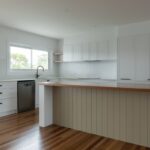
Many layouts can also incorporate a kitchen island or peninsula, which adds extra workspace, storage, and seating.
Before diving into specific layouts, it’s worth understanding the difference between two popular kitchen features.
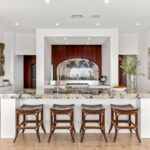
A kitchen island is a freestanding bench accessible from all sides. Islands are ideal in open-plan homes and provide extra preparation space, storage, and often seating for casual dining.
The island bench depth would typically measure 900mm to 1200mm, depending on the size of the room. This generally accommodates 600mm of storage on the working side, while allowing a 300mm overhang for comfortable seating. If including seating, allow approximately 610mm of width per stool or chair.
A kitchen peninsula, on the other hand, is connected to the main kitchen on one side. This creates additional bench space but is accessible from three sides rather than four. Peninsulas can be a great solution in smaller kitchens where a full island may not fit comfortably.
Both options can significantly improve functionality depending on the layout and available space.
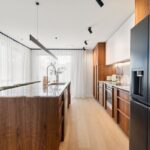
A galley kitchen is one of the most efficient and practical kitchen layouts. It consists of cabinetry and appliances arranged along one or two parallel walls, creating a corridor-like workspace.
A single row galley kitchen (sometimes called a one-wall kitchen) places all cabinetry and appliances along a single wall. This layout works well in smaller homes, apartments, or open-plan spaces where the kitchen needs to be compact and streamlined.
A double row galley kitchen features two parallel walls of cabinetry, creating a central aisle between them. This layout is common in homes where space is limited but maximum storage and functionality are required.
Historically, galley kitchens were often tucked away in older homes and not used as social spaces. However, they can also be adapted beautifully in larger modern homes.
In open-plan designs, an island can act as one side of the galley, creating the parallel layout while maintaining an open feel. Additional features such as butler’s pantries or banquet seating can also complement this style.
One of the biggest advantages of galley kitchens is that there are no awkward corner cupboards. Every cabinet can be fully utilised, which makes this layout incredibly efficient for storage with flexible locations for appliances.
Design options might include:
A key measurement to keep in mind for galley kitchens is the distance between the two sides. Ideally, there should be 1.2 to 1.5 metres between benchtops to allow comfortable movement.
An L-shaped kitchen is designed along two adjacent walls that meet at a right angle, forming an “L” shape.
This layout opens up the centre of the room, leaving space for:
The working triangle is typically divided across the two walls. Depending on the kitchen size, the sink and cooktop may sit on the same wall or opposite walls, while the fridge is usually positioned at the end of one run of cabinetry.
L-shaped kitchens are particularly well suited to open-plan homes, as the absence of a third wall allows the kitchen to connect seamlessly with adjoining living or dining spaces.
However, one thing to consider is the corner cupboard created where the two walls meet. This can become a deep storage area that is difficult to access if not planned properly.
With custom joinery solutions such as corner drawers, pull-out storage systems, or clever shelving, this space can be fully utilised.
Another important factor is ensuring the fridge remains accessible without interrupting the main flow of movement through the kitchen.
A U-shaped kitchen consists of cabinetry and appliances arranged along three connected walls, forming a “U” shape.
This layout provides:
U-shaped kitchens are highly functional and can work well in both small and larger spaces. They provide generous storage, ample bench space, and a defined cooking area.
Again, where possible allow for 1.2 – 1.5 metres between benchtops so it is comfortable for 2 people to be working in the kitchen at the same time.
Another key aspect to consider with this layout is the presence of two internal corners, which require thoughtful cabinetry design to ensure the space is used effectively.
When designed well, U-shaped kitchens offer an efficient workspace with everything easily within reach.
A G-shaped kitchen is essentially a U-shaped layout with the addition of a peninsula extending from one side, creating a shape that resembles the letter “G”.
This layout provides:
However, because modern homes often favour open-plan living, G-shaped kitchens can sometimes feel more enclosed and restrict visual openness.
For this reason, they are less common in contemporary designs but may still be suitable for homes where maximising storage and workspace is the priority.
The ideal kitchen layout ultimately depends on your home’s architecture, available space, and how you live day to day.
At Horizon Joinery in Woolgoolga, we work closely with homeowners across the Coffs Harbour and Mid North Coast region to design kitchens that balance practical functionality with beautiful craftsmanship.
Whether you’re renovating an existing space or building a new home, thoughtful layout planning is the foundation of a kitchen that will serve your family for many years to come.
If you’re considering a new kitchen, our team would be happy to help you explore the best layout options for your home.
LET’S TALK
Have a project in mind? Whether you’re renovating, building new, or just exploring ideas, we’d love to hear about it.
Share a few details and let’s start shaping your vision into custom-crafted reality.